 The Boardroom
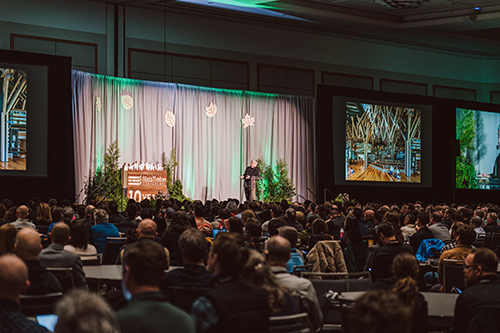 Keynote Presentations
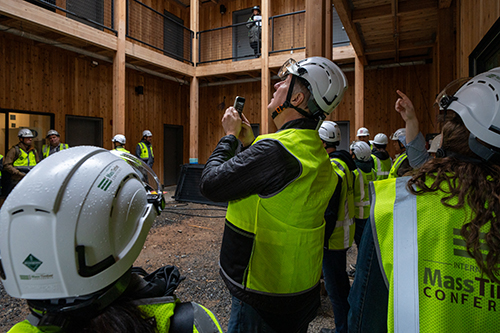 Building Tours
 Workshops
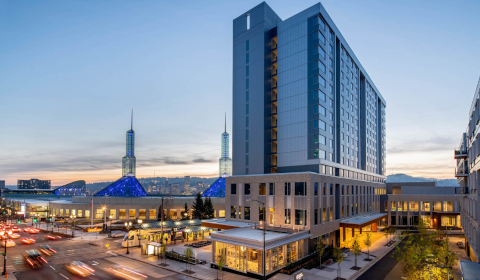 Book Your Hotel »
 Negotiated Airfare
 Reserve Your Booth »
 Sponsorship Download »


Wednesday, April 1, 2026
From Panel to Pod: Case Studies in Modular Mass Timber Execution
Oregon Ballroom 203Moderator:

Mass Timber at Scale: Lessons Learned from Volumetric Modular Construction
Stora Enso has completed over 23,000 projects globally, and a small but increasing share of these projects are using a modular volumetric approach. This presentation will use several case studies from our volumetric led clients, with deep dives into how they achieved standardization at a mass scale, while still being able to retain architectural freedom and avoid “cookie cutter” repeated designs. We will look at the design and connection details, building physics, etc., but more importantly focus on the lessons learned, and challenges faced, as well as how they were overcome.
Stora Enso at one point owned its own volumetric factory in Finland and so knows firsthand the challenges and benefits of volumetric construction and now are honored to supply some of the leading mass timber volumetric companies globally. This will be a case study-led presentation for interesting and real-life examples of what can be achieved, and how — from design restrictions to installation on site.

From Panelized to Volumetric: Lessons in Modular Mass Timber From Matt’s Place
Matt’s Place 2.0 (MP2.0), completed in 2023, demonstrates how cross-laminated timber (CLT) can deliver modular, rapidly deployable, cost-effective, and dignified housing for families living with ALS. This 1,500 sf, three-bed home uses exposed CLT walls and ceilings to create a biophilic, healthy interior environment while streamlining fabrication and assembly. Innovative module-to-module joints align across floor, wall, and roof planes to integrate structural splines, weather barriers, and accessible service chases, allowing the wood to remain visible and perform structurally.
This presentation will review lessons learned from MP2.0, including why the team pivoted from a fully volumetric approach—originally designed for room-sized modules that could fit on a truck bed—to a panelized modular system that simplified fabrication, transport, and on-site assembly based on North American manufacturing capabilities at that time.
Building on MP2.0, Matt’s Place 3.0 (MP3.0) expands these principles into a three-story, nine-unit CLT apartment building now in design. This next iteration explores full volumetric fabrication, multi-module stacking, and hybrid foundation systems to further reduce construction time and embodied carbon.
Together, these projects show how mass timber’s precision, sustainability, and light-carbon footprint make it uniquely suited to modular construction, offering replicable strategies for off-site fabrication, transport logistics, and scalable, high-performance housing.

UC Santa Cruz: Kresge College Modular Construction
California’s public universities face a severe housing shortage, with thousands of beds needed to support growing student populations. Traditional construction is costly, slow, labor-intensive, and disruptive. At UC Santa Cruz, Truebeck Construction addressed this challenge through modular construction in the Kresge College Renewal project.
The campus required urgent housing expansion and seismic upgrades for its aging 1970s infrastructure. The $250 million redevelopment replaces 11 buildings with 186 rooms and 592 beds, adds eight new modular dormitories, a new town hall, renovates five academic buildings, and demolished 10 structures.
Due to the campus’s remote location and labor shortages, Truebeck used prefabricated CLT (cross-laminated timber) decks, walls, and bathroom pods built offsite. These pods support seismic loads, accelerate construction, reduce onsite labor, and improve quality while minimizing disruption. Mass timber also offers biophilic benefits, lowers fire risk, and reduces building weight.
Truebeck partnered with the carpenters’ union to streamline trades, cutting labor needs from 400 to 200 workers. This reduced costs by 25–40%, preserved union integrity, and avoided dual-gate issues. Modular construction is not just efficient—it’s essential for building in remote areas with limited labor.

Modular Mass Timber for Scalable Buildings
This session explores how mass timber can be effectively integrated into modular construction through the development of a scalable, fabrication-oriented building system capable of supporting a wide range of programs, including multifamily housing, workforce housing, student residences, schools, offices, and hotels.
Drawing from lessons learned on the recently completed Knight Building in Big Sky, Montana, the first large-scale modular mass timber project in the U.S., the presentation will examine key design and planning principles for modular mass timber construction. Topics include structural and dimensional strategies, delineation of off-site versus on-site scopes, and the integration of building systems within transportable CLT volumetric modules.
The session will emphasize the importance of comprehensive digital coordination and early collaboration among architects, engineers, and fabricators to achieve precision manufacturing, efficient assembly, and consistent quality. It will also address the current challenges of designing modular mass timber buildings, including limited testing data related to fire ratings, firestopping, and acoustic performance.

Modular Learning Environments
This presentation explores how modular mass timber classrooms can transform the delivery of learning environments. School districts today face constant enrollment fluctuations driven by demographics, housing growth, and shifting community needs. Traditional construction is often too slow to respond, while portable classrooms, though quick to deploy, frequently compromise on quality, comfort, and integration. Drawing on Kalesnikoff’s experience delivering CLT and glulam structures across educational projects, this session highlights how mass timber enhances learning environments through natural materials, improved acoustics, and biophilic design. To address speed and flexibility, Kalesnikoff has expanded into volumetric modular construction, combining prefabrication with high-performance timber systems.
These modular classrooms are built in a controlled factory setting and installed rapidly on site, delivering permanent-quality spaces in a fraction of the time. More importantly, they can be added, reconfigured, or relocated as enrollment needs change, allowing schools to treat classrooms as adaptable assets rather than fixed infrastructure. The session will also feature a full-scale demonstration classroom on display at IMTC Hall E. Attendees will gain insight into how modular mass timber offers a scalable, sustainable, and student-focused solution for modern education.

Session CEUs
Course Description
This course presents detailed case studies illustrating the evolving integration of mass timber systems with panelized and modular construction methodologies. Through real-world project examples—from volumetric standardization strategies to panelized modular housing—participants will examine design, detailing, fabrication, logistics, and installation challenges unique to off-site mass timber construction. Emphasis will be placed on how mass timber enhances sustainability, structural performance, and biophilic design while addressing key considerations such as fire performance, seismic resilience, transportation logistics, dimensional coordination, and on-site assembly efficiency. Attendees will gain actionable insights into interdisciplinary collaboration, planning and fabrication workflows, and innovative connection strategies that support safer, faster, and more resilient project delivery.
Learning Objectives
- Describe key modular mass timber delivery strategies and how panelized and volumetric systems can improve construction efficiency, project quality, and site safety relative to traditional construction methods.
- Analyze critical design and detailing decisions that impact fire performance, structural integrity, constructability, and site logistics in modular mass timber projects, including dimensionally coordinated connections and building physics concerns.
- Evaluate the sustainability and biophilic benefits of mass timber in modular construction, particularly through reduced embodied carbon, accelerated timelines, and occupant well-being considerations.
- Apply lessons learned from case study examples to improve coordination between architects, engineers, fabricators, and contractors during design and off-site fabrication to achieve safer and higher-performance project outcomes.