 The Boardroom
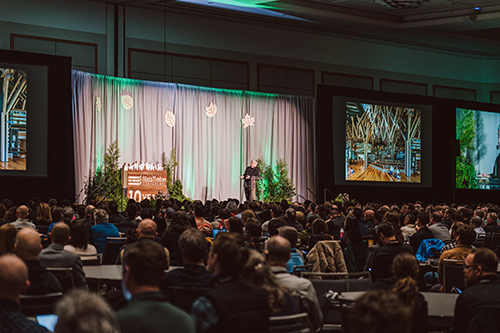 Keynote Presentations
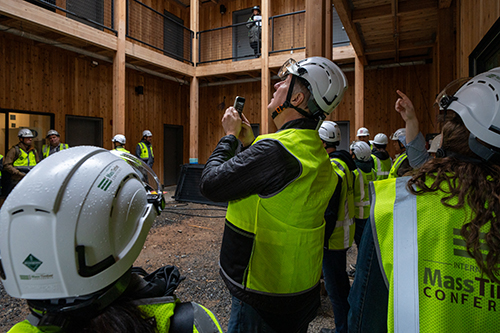 Building Tours
 Workshops
 Book Your Hotel »
 Negotiated Airfare
 Reserve Your Booth »
 Sponsorship Download »


Thursday, April 2, 2026
Mass Timber Case Studies: Building Systems Integration & Material Expression
Rooms C123–124Moderator:

Designing Building Systems for Mass Timber: David Rubenstein Treehouse at Harvard University
Clients are attracted to mass timber construction for lowered embodied carbon, construction time savings, and the naturally warm, inviting environment it brings to a project. That last point, aesthetics, is often challenged by the necessary systems required in modern buildings.
The David Rubenstein Treehouse at Harvard University, the first university-wide conference center and mass timber building on Harvard’s campus, was designed with the goal of maximizing exposed timber and having systems follow architecture. The raised floor system of the upper levels was critical to achieving both Harvard’s increased fresh air requirement and keeping ceilings clear of ductwork, plumbing, electrical and AV routes. Systems design leveraged this under floor space to maximize clear timber ceilings, however, the atrium, which does not have a raised floor, demanded a different approach. The atrium required careful planning and coordination to ensure sprinklers, lighting and life safety devices were integrated and complementary to the project geometry.
This project demonstrates the opportunities, challenges and strategies at the intersection of systems design and architecture.

Freedom Mobile Arch, Vancouver, BC
Robert Jackson, Partner at Fast + Epp, will present on the new PNE Amphitheatre in Vancouver, featuring one of the world’s longest-spanning timber structures with a 350 ft clear-span roof formed by three-barrel vaults and sixty glulam arches arranged in intersecting lines. An innovative three-point support system with concrete buttresses enables a lightweight, open canopy that frames the site’s natural surroundings. The project showcases the forefront of mass timber design, integrating structural optimization and acoustic detailing to meet ambitious performance, sustainability, and architectural goals.
From concept through completion, the case study will explore form-finding, construction sequencing, fabrication, and transport considerations, as well as sustainability-driven design decisions. Attendees will see how advanced timber design techniques and geometric optimization informed critical choices throughout the project, as well as how applied research was used to refine this expressive structure through both digital workflows and physical prototyping at Fast + Epp’s Concept Lab. Participants will gain insight into how these methods enabled this expressive and efficient mass timber structure at a scale rarely seen in the industry.

The Bloomberg Student Center at Johns Hopkins University
The Bloomberg Student Center, designed by Bjarke Ingels Group and Shepley Bulfinch, with knippershelbig as structural and façade engineers, serves as a new, multifunctional hub for student life on Johns Hopkins University’s Homewood Campus. The 143,000 sf facility forms a gateway to the campus through a composition of highly transparent, mass timber-framed volumes with cascading roof geometries that descend the sloped topography toward Charles Street.
The presentation will outline the overall design approach and examine key engineering strategies that were critical to the realization of the project’s ambitious architectural design:
- The structural design of the cascading roofscape, utilizing dowel-laminated timber (DLT) panels and glulam beams, and the integration of multiple lateral force-resisting systems to support expansive glazed façades and uninterrupted interior volumes.
- The hygroscopic nature of timber, which causes dimensional changes due to moisture exchange, can present challenges in coordinating envelope systems. The discussion will cover detailing methods and tolerance strategies employed to mitigate construction tolerances, structural deflection, and moisture variability without compromising performance or aesthetics of finely detailed façade systems.
- The seamless coordination, integration and partial concealment of systems within the mass timber framework, achieved through strategically located ceiling trenches and penetrations in structural members.

Milo's Market: A Mass Plywood Pavilion
Milo’s Market, a mass plywood convenience store, establishes brand identity centered on healthy, quality living and a welcoming atmosphere. The wood structure creates a place that feels good to inhabit — whether enjoying lunch, sipping coffee outdoors, or grabbing a wholesome snack.
Celebrating the honesty of massply, the building achieves a modern, clean aesthetic that connects to the local vernacular, honors regional farmers, and resonates with everyday shoppers. Sustainability is woven into every aspect of the design — from form and material selection to the overall character of the space.
Flared mass plywood columns meet plywood beams supporting the simple monopitch roof. Single 10’x48’ sheets of 8″ thick plywood are used to cut all structural members. The ceiling is 2” thick massply. The V-shaped tank and pump butterfly canopy is cut from a single massply panel.
Natural light floods the interior, highlighting the wood ceiling, structural elements, and suspended trellis-like structures that accentuate specific areas within the store.
The exterior’s expansive windows, warm wood, and stone anchor Milo’s Market. The bright green signage stands out against the building’s natural palette, while displays of fresh, local foods in market carts animate the storefront — visually expressing the store’s values of healthy, sustainable living.

Session CEUs
Course Description
This course presents a series of built case studies illustrating the integration of mass timber across diverse project types, including civic, educational, and small-scale commercial buildings. Through detailed project narratives, design and construction professionals share strategies for coordinating structural systems with mechanical, electrical, and life-safety infrastructure in exposed timber environments. The session addresses moisture management, dimensional tolerances, and detailing approaches that balance performance requirements with architectural intent. Attendees will gain practical insight into how integrated design and construction decisions influence durability, sustainability, and spatial quality in contemporary mass timber projects.
Learning Objectives
- Detail methods for integrating building systems with exposed mass timber structures in a manner that maintains fire protection, accessibility, and life-safety performance while supporting architectural intent.
- Evaluate moisture management and detailing strategies that protect mass timber structural elements, reduce the risk of decay or mold, and contribute to occupant health and long-term durability.
- Assess how dimensional variability, construction tolerances, and structural system selection influence enclosure performance, fire resistance, and safe system coordination in mass timber buildings.
- Apply lessons from multiple mass timber case studies to improve interdisciplinary coordination and risk mitigation, supporting safe construction practices and long-term building welfare across diverse building typologies.