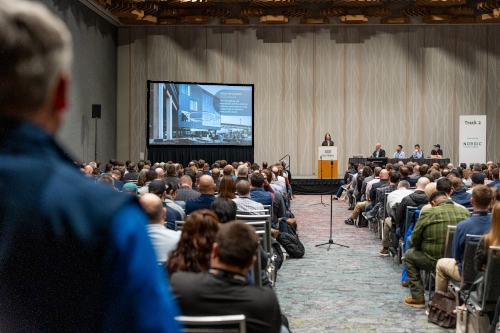
 View the Agenda
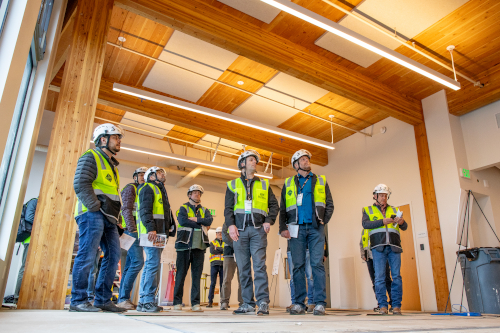 Book a Building Tour
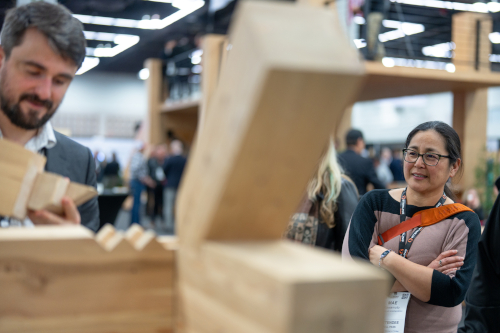 Book Your Exhibit Space
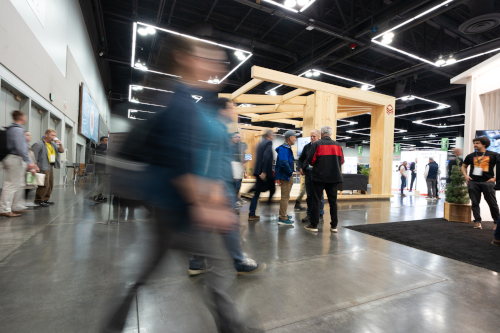 Explore the Exhibit Hall
 Become a Sponsor
 View Sponsors & Partners
 Reserve Hotel Rooms
 Discounted Plane Tickets
 Read Case Studies
 Download Past Reports

Thursday, April 2, 2026
Designing for Climate Resilience: Mass Timber’s Use in Extreme Conditions
Oregon Ballroom 204Moderator:

Mass Timber Adaptation in Hawai‘i’s Diverse and Changing Climates
Shaped by the tradewinds and the volcanoes, Hawai‘i presents a uniquely complex context for climate resilient mass timber construction. The remote island geography, diverse microclimates ranging from rainforest to semi-arid, and rapidly changing weather patterns as well as increasing extreme weather events heighten the importance of detailing, material protection, material sourcing, and construction strategies that enhance mass timber’s adaptability and sustainability as a building material.
Two current projects, the Habitat for Humanity Bunkhouse, scheduled to begin construction soon, and the Anahola Residence, currently under construction, illustrate strategies for adapting mass timber to Hawai‘i’s changing climate. Design considerations include moisture protection and resilience in high rainfall and sea spray zones, termite resistant treatment and detailing, and structural strategies that are not only resilient against extreme winds and precipitation but also safeguard the diminishing natural resources of Hawai’i and the Pacific Ocean.
Experience from these projects underscores the potential of mass timber’s climate-adaptive and climate-supportive capacity while revealing lessons learned during construction. The work illustrates how detailing, protection strategies, and lifecycle considerations can strengthen resilience in a remote island context during an extreme climate change.
Mass Timber for Climate Resilience: Lessons from the Coasts of Mexico
Climate change demands architecture that adapts rather than resists. Across Mexico’s Pacific coasts, mass timber has proven capable of both mitigating climate impact and thriving under extreme environmental conditions. MICMAC’s work explores the use of tropical hardwoods — such as Tornillo, Red Grandis, and Cumaru — transformed into glulam systems capable of withstanding humidity, salinity, and hurricanes. Through custom stainless-steel, aluminum, and epoxy connections, these systems achieve precision, durability, and low embodied carbon in some of the world’s most challenging climates.
Projects like The Ritz-Carlton, a beachfront resort in Nayarit, and Rancho XXII, a jungle retreat near Vallarta, demonstrate how engineered tropical glulam can perform where concrete and steel often fail. Prefabrication, digital modeling, and intelligent detailing ensure efficiency, resilience, and reduced environmental impact.
The lessons from Mexico’s coasts reveal that resilience equals precision, local knowledge drives innovation, and designing with nature leads to enduring architecture. In tropical and coastal contexts, mass timber proves that sustainability and resilience are not opposites — they are mutually reinforcing.
“Resilience is not about resisting the climate — it’s about learning to build in harmony with it.”
Resilient Design Strategies for WUI Communities
Approximately 40% of the U.S. population lives in Wildland-Urban Interface (WUI) zones, often surrounded by overstocked forests that intensify wildfire risk. The need for fire-resilient homes is urgent, yet these high-risk communities remain underserved by current research and building standards. This presentations discusses fire-resilient Type IV construction strategies for mechanically laminated decking applicable to homes in WUI zones. Through linking building construction and forest management, we foreground building solutions that are mutually reinforcing.
Recent building code updates expand Type IV residential use, marking a critical moment for defining mass timber’s role in WUI contexts. We offer strategies for achieving code-compliant, WUI-informed, mass timber assemblies for residential construction. By reimaging mass timber through the lens of wildfire adaptation, this presentation advances architectural practice toward low-carbon and fire-resilient mass timber housing for WUI communities.

Retrofitting Commercial Building Facades With Mass Timber for a Resilient Future
This presentation explores an innovative way to upgrade older office buildings using prefabricated mass timber panels. Developed by a team from the University of Oregon, Oregon State University, Swinerton, and FFA Architecture and Interiors, the system replaces conventional steel retrofits with prefabricated mass timber panels on the facade to improve earthquake safety, energy efficiency, and indoor comfort.
Using a four-story steel frame office building as a case study, the team designed a new façade that helps buildings stay functional during power outages, extreme weather or seismic events. The retrofit includes better insulation, more natural light, and operable windows for fresh air — all while cutting energy use nearly in half for a fraction of the cost of new construction.
This approach offers a practical solution for updating aging buildings to meet modern climate and safety goals and opens new pathways for adaptive reuse. Join us to learn how mass timber can transform the way we think about building retrofits. The team will share architectural and structural details, building performance modeling, and a detailed cost model.

Session CEUs
Course Description
Across a range of geographies, mass timber has proven capable of reducing climate impacts of the built environment while performing well under a variety of environmental conditions. From coastal communities subject to high winds and sea spray to wildland-urban interface zones that face threats from wildfires, tropical environments that experience high humidity, and continental climates that require fluctuating temperature control for occupant comfort, we are constantly seeking better performance from our buildings. At the same time, many of these locations are experiencing increasingly extreme weather events. This session highlights the unique environmental challenges of four contrasting locations and discusses effective design and construction strategies for using mass timber to build adaptable, climate-resilient buildings.
Learning Objectives
- Learn about mass timber systems being used in coastal Mexico to improve structural resilience, occupant safety, and long-term durability in humid, hurricane-prone coastal environments.
- Evaluate code-compliant mass timber construction strategies in wildland-urban interface (WUI) zones to reduce wildfire risk, enhance life safety, and support resilient housing solutions that protect occupants and surrounding communities.
- Explore how mass timber façade systems can enhance occupant welfare by improving thermal comfort, seismic safety, and building adaptability in the face of extreme natural disasters.
- Understand mass timber design and construction strategies for Hawaii’s diverse microclimates to enhance occupant health and safety while protecting the island’s natural resources.