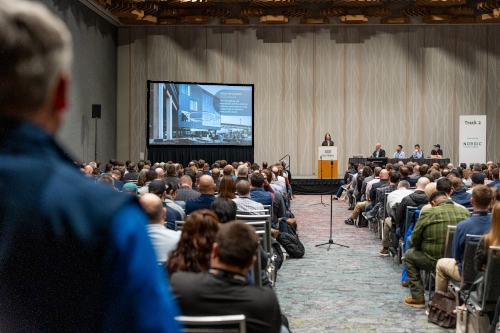
 View the Agenda
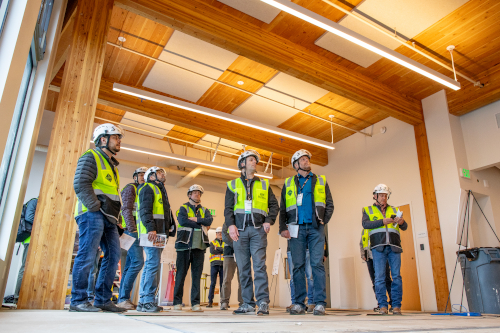 Book a Building Tour
 Book Your Exhibit Space
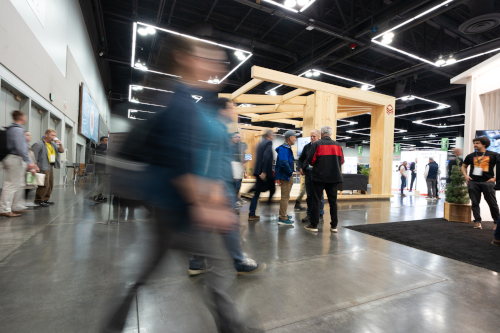 Explore the Exhibit Hall
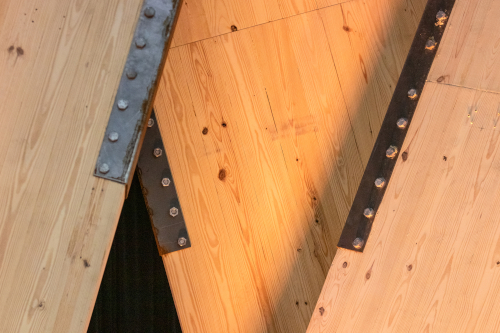 Become a Sponsor
 View Sponsors & Partners
 Reserve Hotel Rooms
 Discounted Plane Tickets
 Read Case Studies
 Download Past Reports

Thursday, April 2, 2026
Supply Chain Resilience: Forests, Markets, and Mass Timber
Oregon Ballroom 203Moderator:

Pacific Northwest Regional Mass Timber Market Study
The 2025 Pacific Northwest Regional Mass Timber Market Study offers the most comprehensive assessment to date of the region’s mass timber ecosystem including forest resources and fiber supply to manufacturing capacity, project demand, and economic impacts. The study quantifies how Oregon and Washington have become U.S. leaders in mass-timber adoption, supported by abundant timber resources, advanced engineered-wood manufacturing, and a deep tradition of wood construction. While the study’s primary focus is the Pacific Northwest, data were gathered for all of North America to provide comparative context on raw material supply, manufacturing capacity, and market demand. This continental perspective allows the PNW’s strengths, gaps, and growth potential to be understood relative to the broader mass-timber economy. Findings show that mass timber remains a small but fast-growing segment with the PNW leading the continent in per-capita adoption. Regional manufacturers operated at less than one-third of capacity, signaling substantial room for expansion. With supportive policy, investment, and supply-chain innovation, production could exceed one million m³ and $2 billion annually by 2035. This panel, featuring the study’s four coauthors, will present key findings and outline pathways for building a globally competitive, low-carbon mass-timber economy.

Growing the Mass Timber Supply Chain in Colorado
The Southwest is a rapidly growing market for mass timber, but without in-state manufacturing what are the pathways to cultivate a regional supply chain and support the local mill and forest industry? The City of Boulder’s Western City Campus expansion worked closely with Timberlab, KL&A, Anthem, Saunders Construction, and SmartLam to develop a replicable pathway to utilize out-of-state manufacturing with lamstock sourced from Colorado’s Blanca Forestry Products mill.
The project uses two types of CLT layups that feature Colorado wood. For the roof/floor systems with high strength requirements, the team designed a hybrid panel with Douglas fir from the north and spruce-pine-fir (SPF-S) from the south for the core layers. Additionally, the building’s public entries and the stair core panels feature an exposed, 100% Colorado SPF-S panels.
This market innovation makes the Western City Campus the first commercial building in Colorado to use Colorado-grown, structural mass timber. It connects the state’s struggling mill industry with new, high-value markets and helps scale the active management needed to restore Colorado’s forest health and wildfire resilience. The project proves the demand for Colorado-based mass timber and provides a replicable pathway to utilize Colorado timber until a manufacturer is attracted to the state.

Sustainable Forestry: A Living Promise to Our Environment and Our Communities
Mass timber can only be as reliable as the forests that supply it. Before a mill can scale production or a builder can count on delivery, you need a steady, long-term fiber base — wood that’s available in the right volume and quality year after year. That resilience is built through sustained stewardship across the full landscape – private working forests, state and federal forests, and tribal forests managed for long-term health and productivity.
Sustainable forest management is what makes that consistency possible. These forests are actively renewed, not depleted: planting, thinning, and harvest cycles are designed to keep forests productive over time, with hundreds of millions of seedlings planted each year to ensure future supply for the next generation of innovative wood products.
Mass timber is serving as an important bridge between public and private timberland and the architects, engineers and developers creating the built environment. As our nation’s forests continue to face unprecedented challenges, Mass Timber and other emerging technologies will play a pivotal role enabling the healthy markets that allow for the sustained management of healthy forests.

Session CEUs
Course Description
This course examines the interconnection of policy, forest product infrastructure, and strong markets for wood products—and their collective impact on forest health. Beginning with an overview of sustainable forest management, the session will highlight how long-term stewardship across public, private, and tribal lands ensures reliable fiber supply, supports forest health, and enables mass timber to function as a bridge between working forests and the built environment. Next, we will examine how forest resources, manufacturing capacity, project demand, and policy alignment have positioned the Pacific Northwest as a continental leader, while identifying gaps and growth opportunities across North America. Lastly, a Colorado-based case study will illustrate how innovative sourcing strategies and hybrid CLT design can connect local forests and mills to high-value mass timber projects, even in regions without in-state manufacturing.
Learning Objectives
- Identify the factors that have contributed to a healthy mass timber supply chain in the Pacific Northwest and how policy, investment, and innovation can support similar growth of the green economy in other regions.
- Explore proven and repeatable strategies for combining out-of-state manufacturing with in-state forest resources, bringing code-compliant, sustainable building materials to regions lacking local manufacturing capacity.
- Evaluate how sustainable forest management practices support a consistent and reliable supply of wood fiber while promoting the long-term welfare of the built and natural environments.
- Understand the unintended environmental and economic consequences of a reduced demand for forest products—and how the growing demand for mass timber can support sustainable forestry, resilient supply chains, and healthy ecosystems.