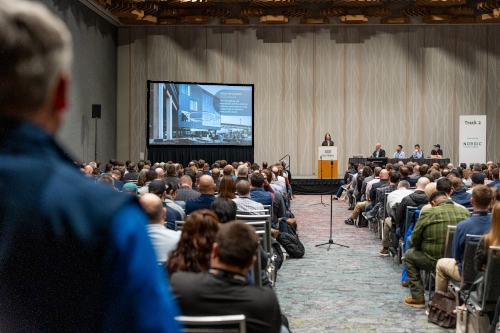
 View the Agenda
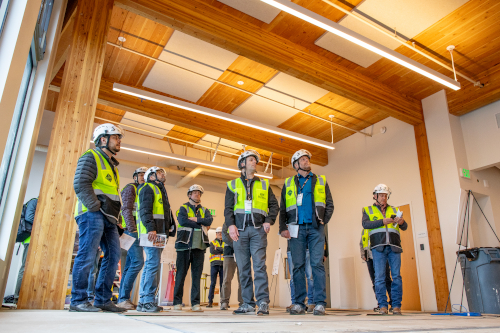 Book a Building Tour
 Book Your Exhibit Space
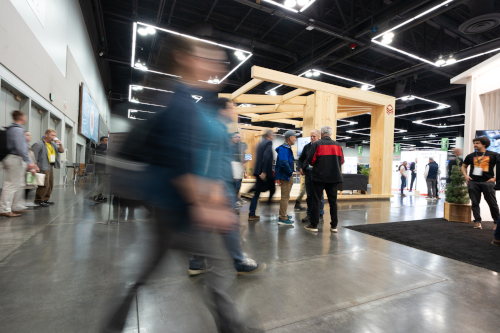 Explore the Exhibit Hall
 Become a Sponsor
 View Sponsors & Partners
 Reserve Hotel Rooms
 Discounted Plane Tickets
 Read Case Studies
 Download Past Reports

Thursday, April 2, 2026
Mass Timber Case Studies: Innovation in Design, Delivery, and Performance
Rooms C123–124Moderator:

Timber Takes Flight: How We Built Hangar 4, Air New Zealand’s Mass Timber Hangar
Hangar 4 isn’t just another big shed — it’s one of the world’s largest mass-timber aircraft hangars and a turning point for how large-scale timber projects are delivered in the Southern Hemisphere.
Spanning 97 metres wide and 36 metres high, the Air New Zealand Hangar 4 project pushed mass-timber engineering to new limits, nine giant trusses, 38 tons each, stood on a live airport site, during COVID delays, design shifts, and unpredictable Auckland weather.
In this 15-minute session, Jimmy Corric walks through the full journey — from design challenges and temporary works to lessons learned about risk placement, weather-tightness, sequencing, and collaboration.
Expect a candid, practical look at what worked, what didn’t, and why small innovations (like liquid-applied protection, hinged baseplates, and self-performed installation) made a huge difference.
The session finishes with takeaways that matter across the global timber industry, how to design for temporary works, integrate prefabrication early, and build teams that think like fabricators as much as builders.
It’s a grounded, real-world case study for anyone serious about scaling timber — without losing control of programme, cost, or sanity.

Less Mass Timber: Building Like a Boat for Mariners Hall
With an eye toward sustainability and resilience through a less is more strategy, this session explores how early collaboration among the architect, structural engineer and contractor maximized parametric design tools to minimize materials and create an elegant, multi-directional, long-span curved exhibit hall for the Columbia River Maritime Museum.
Inspired by wooden boat building, the team shaped and framed an exposed timber structure that appears to float lightly overhead while anchoring firmly to its coastal site. Set between a trolley line and highway, the build curves in both plan and section. The building’s curving glulam ribs maximize interior volume and evoke the forms of wooden boats and cresting of ocean waves.
Built around a 52-foot Coast Guard Lifeboat, the advanced timber structure will house 26 vessels and a hanging Coast Guard Helicopter to tell the stories of mariners at this dramatic setting where the Columbia River meets the Pacific Ocean.
Attendee takeaways:
- Early design and structural team collaboration and parametric design tools to reduce material use and minimize costs
- Maximize hybrid wood and steel systems for visual and structural performance
- Lessons learned from off-site pre-fabrication, erecting double-curved roof forms on site and integrated moisture controls systems


University of Victoria Indigenous Law Wing: Mass Timber as an Instrument of Reconciliation
The use of mass timber for the Indigenous Law Wing at the University of Victoria is integral to the building’s role in advancing Indigenous Reconciliation. Housing the world’s first joint degree program in Indigenous and Common Law, the design emerged from intensive consultation with local First Nations, inspiring an “extended forest” concept that brings the surrounding forest ecosystem — considered sacred and integral to the practice of law — into the building itself.
The 26,000 sf hybrid structure features a mono-sloped CLT roof deck supported by 85 natural Douglas-fir columns and supplementary HSS steel members, creating an uninterrupted field of spruce-pine-fir above a dense and expressive “forest of columns.” Nineteen columns were sourced from the site and blessed by Elders prior to being felled and cured for use.
Exposing the mass timber while integrating high-performance envelope and HVAC systems required careful detailing and coordination of mechanical, electrical, and moisture-management systems. Executed amid Pandemic-driven escalation and supply chain challenges, close collaboration was required among design team, Construction Manager, and client to identify and execute a financially viable scheme. The result is both a technical exemplar of mass timber construction and a deeply meaningful expression of wood in service of social justice.

WARP10: Mass Timber Construction in Pharmaceutical Manufacturing
The first of it’s kind in the United States, Warp10 is 196,000 square foot pharmaceutical manufacturing facility in Research Triangle Park, North Carolina. The project is designed to achieve Zero Embodied Carbon utilizing a mass timber structure. The facility includes Current Good Manufacturing Practice (cGMP) clean rooms, warehousing, refrigerated storage, laboratories, offices, and a central utility plant.
The primary structure is composed of mass timber framing including glulam columns and beams with cross laminated timber (CLT) wall, floor, and roof panels. The project includes a timber curtain wall and Shou Sugi Ban charred Accoya wood siding to balance the project’s aesthetic and zero carbon goals.
The focus of this presentation will be to discuss the challenges faced by the architectural and structural team to balance the programmatic and regulatory requirements of manufacturing and warehousing with the overall net zero carbon goals. This includes finding solutions for large clear structural spans and organic materials in manufacturing, moisture management in construction, and decision-making to achieve net zero embodied carbon. This presentation aims to show how mass-timber can be successfully utilized in biotech and warehousing applications. The envelope of the building is constructed with the building slated to be operational in early 2027.

Two Paths to Timber: A Comparative Case Study in Student Housing
Mass timber is rapidly gaining traction in student housing. Its efficiency with repeatable floor plates and construction speed benefits aligning with academic schedules make it a practical, sustainable choice for campuses. Universities, often more willing than private developers to embrace innovation, are leading the charge.
This presentation dives into two bold mass timber student housing projects at Colorado universities — each delivering approximately 600 beds, but through dramatically different approaches. One is a multi-building campus of 5-story hybrid mass timber/light frame bearing wall structures; the other, a 12-story post-and-beam mass timber tower. Both illustrate the unique potential — and trade-offs — of timber construction in higher education.
We’ll explore why and how each university chose mass timber, the design and construction journeys, and the outcomes in terms of financial feasibility, performance, and student impact.
Join us for a comparative case study of two of Colorado’s newest and most ambitious student housing projects: Mines Park Housing at Colorado School of Mines (opened August 2025) and Summit House at Metropolitan State University of Denver (opening August 2027).
Discover how innovation, constraints, and context shaped two very different paths to mass timber success.

Session CEUs
Course Description
This course presents an in-depth exploration of real-world mass timber projects that push the boundaries of scale, sustainability, cultural expression, and technical performance. Through a curated series of case studies – from one of the world’s largest mass timber aircraft hangars to architecturally expressive civic and educational facilities, net-zero pharmaceutical manufacturing, and comparative student housing models – industry leaders share practical insights on design strategy, structural coordination, fabrication, and construction execution. Attendees will gain a comprehensive understanding of how thoughtful integration of mass timber impacts material efficiency, project delivery risk, environmental performance, and the broader cultural and programmatic goals of each project.
Learning Objectives
- Analyze the design and construction strategies used to achieve structural performance and constructability in large-span and complex mass timber projects, including solutions for sequencing, temporary works, and hybrid systems integration.
- Evaluate approaches to material efficiency and sustainability, such as parametric design to reduce material use, strategies for minimizing embodied carbon, and integrating mass timber into hybrid structural systems.
- Understand the role of interdisciplinary collaboration across architecture, engineering, fabrication, and construction teams to address challenges including moisture management, envelope detailing, and creating healthy environments.
- Compare diverse mass timber typologies and delivery models, from industrial facilities and cultural/academic buildings to student housing, identifying key decision points and trade-offs that influence project outcomes.